the situation pt. 4

i worked at this rundown old dollar theater for number of years, starting at the end of high school. my friend got me the job, and three of the five other employees were people that i knew from school, so it was a good situation for me. the woman who was the manager also took a liking to me relatively quickly, so i got comfortable there. it was an easy job, and we could, basically, do whatever we wanted, because the owner lived in Florida and rarely visited, so we basically functioned like a group of friends who got paid to hang out.

the only time i didn’t feel comfortable there was when we had to hire a new person, which happened regularly (because it was a shitty high school job and people left or got fired regularly). sometimes, it was people that one or more of us knew, and the acclimation of them into the group was relatively seamless, but even then, i would be the one struggling to connect. even in my element (and this job was as much ‘my element’ as existed then (or maybe ever)), it was tough to talk to a new person. the others would tell the new person “he’s just shy” or however they put it, and it was just how it was.

one girl we hired, though, really seemed to dislike me. Lori barely spoke to me, and i dreaded seeing our names together on the schedule, particularly if it was a tuesday or wednesday night, when we would be the only scheduled workers. we did our jobs, communicated when absolutely necessary, and then sat quietly, waiting for the movies to get out and the next set of customers to get in. i either sat on the bench in the lobby or stood behind the counter, playing with the change in the concession drawer, while Lori sat against one of the exit doors, holding it open while she smoked. after the last show, when concession was shut down, i always told her should could leave early and i would close by myself. i hated closing alone, but i felt a great relief when she was gone, because the pressure was off. it was worse to be around someone who doesn’t like you and doesn’t want you around.

one tuesday, Lori had to call off at the last minute, so the manager, Ronnie, had to work in her place. obviously, i was fine with this. Ronnie and i had developed a great rapport, and i enjoyed working with her (even if we couldn’t get up to the same nonsense i could with some of the other employees). Ronnie kind of mothered me and was protective of me, which was both embarrassing and, even more embarrassingly, kind of nice.

after concession was closed and the money deposited in the safe, Ronnie and i sat on the bench and waited for the last shows to get out. i couldn’t send her home, because she was the boss, and i wasn’t supposed to be letting Lori go home early, anyway (especially because i let her stay on the clock until closing, so she got paid for hours she wasn’t actually there). we talked about Lori, because she was another employee. because i trusted Ronnie, and because i knew she would be sympathetic, i noted how scared i was, not just to work with her, but just of her in general, because of how much she didn’t seem to like me. Ronnie was bewildered by this:

“are you serious?”

i was bewildered by her reaction:

“yeah, i mean, she rarely speaks to me, and she doesn’t even tell me when she needs like quarters or something like that. i’m terrified of her.”

Ronnie smiled.

“you know she thinks you hate her guts, right?”

Ronnie must be joking, i assumed, and i guess she could read the disbelief on her face.

“seriously, she thinks you really, really hate her. she asks everyone what she should do to get you to be friendly. she feels really bad about it, actually.”

i didn’t know how to respond to this, so i leapt to defend myself.

“i’m scared of her. i don’t dislike her, i think she dislikes me.”

Ronnie smiled gently.

“i know, but that’s not how it seems to her. to her, you seem so cold, and even rude. you don’t talk to her at all.”

i felt accused of a crime i didn’t commit.

“i don’t talk to her, because i don’t know what to say. it’s just how i am.”

“i know, and i’ve told her that. everyone has, but it’s hard. think about it this way: for every single other person who works here, you’re super friendly and talkative, but to her- and only to her -you’re completely silent. you don’t even look her in the eye. what else is she supposed to think?”

i was speechless.

“we’ve all told her it’s how you are, that you take a long time to get comfortable with people, but still. it’s the same thing with most of the new people, but she’s having a harder time with it than most. she’s really taking it personally.”

i felt guilty of a crime i didn’t commit.

“it’s not like you’re a bad person, but it can come across as rude sometimes.”

my mind was, to put it mildly, spinning. suddenly, recollections of dozens of interactions with people- people who i was sure, because they had given me (often numerous) unambiguous, umistakable signs of their distaste for me, hated me -flooded my head. or had they? maybe they hadn’t. maybe i had misinterpreted friendly or benign signals, taking them as evidence of a dislike that didn’t exist. maybe i had invented them. i thought about my own behavior, which was always carefully calibrated to be neutral and inoffensive, but now that i thought about it, was maybe just really aloof and cold. i mean, if i don’t speak to you beyond the bare, necessary minimum, and i carefully avoid even making eye contact with you, how else are you supposed to take that except as a message of, at least, disinterest, if not hostility. jesus.

ronnie tried to soften the impact of this revelation, saying “you’re a good person.”

it didn’t really work.

the situation pt. 3

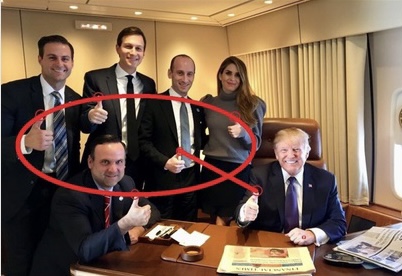
the Q-Anon conspiracy is sprawling and labyrinthine, not so much hiding in plain sight as advertising its existence at every conceivable opportunity, because, as they believe, the satanic pedophile cabal can’t help telling on themselves, and the forces for good battling against the evil are also out here steady giving weird signals. and the signs are everywhere, dude: “once you start to recognize them, you can’t not see them.” everything means something. for example, here’s a seemingly innocuous picture:

more than meets the eye?

it’s a pretty straightforward picture, or so you might think, if you’re still asleep. but if you know, you know:

oh, word?

by simply drawing a line connecting all the thumbs-up gestures from all these garbage people, we can clearly see that a Q is formed, which might be an unmistakable signal that the good guys are in control and the Storm is coming. do your research, pay attention, and it’s right there in front of your face.

unless…

trump’s head looks photoshopped, right?

the situation pt. 2

if you go to the wikipedia page for situation awareness, it quickly becomes clear that the concept is much more complex that it seems on the surface (like pretty much everything is). most of this complexity (or, at least, what i’m most interested in) comes from the three major modes of the concept: perception, comprehension and projection. this is to say, perception of the environment and elements in a given situation, comprehension of their significance, and projection, based on that information, of future status.

the Theoretical model section, then, goes into detail on this idea, including a review of a model formulated by Mica Endsley, an engineer and former Chief Scientist of the USAF. Endsley’s model uses the perception (which is designated Level 1 SA), comprehension (Level 2 SA) and projection (Level 3 SA) terminology, as well as “illustrates several variables that can influence the development and maintenance of SA, including individual, task, and environmental factors.” it also occasions exactly the kind of criticism you would expect a theoretical framework to receive, which is always fun.

two of the model’s “several key factors” are particularly interesting (again, to me):

  • The role of information salience in “grabbing” attention in a data-driven fashion, and the importance of alternating goal-driven and data-driven processing
  • The role of expectations (fed by the current model of the situation and by long-term memory stores) in directing attention and interpreting information

all emphasis mine. 🤔

the situation.

there is a place for me in the military, apparently. so they say. or, so this one guy said one time. i was told, by this dude, that my capacity for awareness of what’s going on around me is actually a desirable skill, one that is useful for the military.

my partner and i were dining with this fellow and his wife, at a restaurant we’d never been to before, and someone at the table mentioned some item on the menu that sounded interesting. i replied that i’d noticed someone being served that dish as we were being led to our table by the host, that the guy over my left shoulder wearing a Tom Brady jersey was probably still eating the thing right now, if they wanted to take a look. the husband (part of the military himself, holding some really specialized position that i never really was able to understand) immediately diagnosed me as possessing excellent situational awareness, which is, basically, exactly what it sounds like: “the perception of environmental elements and events with respect to time or space, the comprehension of their meaning, and the projection of their future status.” he explained that people who have the ability to observe and process environmental information at a really high level (which he had determined, from the fact that i noticed what some guy was eating in a restaurant, i had the ability to do) were very valuable, because they could analyze situations and make recommendations about how and when to take actions. the example he gave was watching a bunch of shops, where there was suspected terrorist activity. someone with this skill might notice that a particular customer who comes in every morning around 9am is absent one day, which might be meaningful and help prevent the loss of life (by, you know, probably causing the loss of someone else’s life).

it actually reminded me of one of my first appointments with my first therapist. i can’t remember what we were talking about, but she stopped and asked me to close my eyes. she said that she did this all the time with clients, asking them to tell her everything they could remember about the room we were in, explaining that, usually, people were unable to describe the room accurately at all and couldn’t recall any correct details. it was an exercise, i think, to illustrate something about how out of touch we actually are with ‘reality,’ showing that we can’t even describe a room that we’re currently sitting in. i’m not totally sure if that was the goal, but what i do remember is that i fucking crushed it, rattling off the smallest details about things like the brand of computer monitor she had and the names of the board games stacked up on a small shelf by the door. she stopped my inventory of the office, remarking that she’d never had anyone answer this challenge so thoroughly and accurately, and i felt sufficiently good about myself (while she, no doubt, adjusted her still-forming understanding of how and why i’m a fucking disaster). recalling that episode felt like some kind of confirmation of this military dude’s assessment of my ability to assess.

so i guess i got that to fall back on. ¯\_(ツ)_/¯