Year of the Middle-Aged Man/what it feels like to be blameless/dumb bitch energy 

If I can cut the crust off of myself, if I can grind down the bits that stick out, smooth over the rougher parts, make myself frictionless and you can’t even notice me. I can make myself so compact that 

I don’t hardly exist at all. 

An impossibly fine white hair surrounded by a thicket of soft brown hair; the light has to catch me just right for you to know I’m there. I stare at the floor so purposefully and so thoroughly. I am camouflaged by it.

I can be perfect. 

Just let me get home, let me summon myself like a reverse superhero. The animals will run to me, they’ll receive comfort from me. I’ll pore over my failures, silent and meticulous and mournful. I’ll masturbate to women who, in a superficial sense, are just like me, because my fantasies never need to acknowledge their reality, so we neither of us exist. We’ll annihilate ourselves together. I keep it together. 

I will continue. 

the situation pt. 4

i worked at this rundown old dollar theater for number of years, starting at the end of high school. my friend got me the job, and three of the five other employees were people that i knew from school, so it was a good situation for me. the woman who was the manager also took a liking to me relatively quickly, so i got comfortable there. it was an easy job, and we could, basically, do whatever we wanted, because the owner lived in Florida and rarely visited, so we basically functioned like a group of friends who got paid to hang out.

the only time i didn’t feel comfortable there was when we had to hire a new person, which happened regularly (because it was a shitty high school job and people left or got fired regularly). sometimes, it was people that one or more of us knew, and the acclimation of them into the group was relatively seamless, but even then, i would be the one struggling to connect. even in my element (and this job was as much ‘my element’ as existed then (or maybe ever)), it was tough to talk to a new person. the others would tell the new person “he’s just shy” or however they put it, and it was just how it was.

one girl we hired, though, really seemed to dislike me. Lori barely spoke to me, and i dreaded seeing our names together on the schedule, particularly if it was a tuesday or wednesday night, when we would be the only scheduled workers. we did our jobs, communicated when absolutely necessary, and then sat quietly, waiting for the movies to get out and the next set of customers to get in. i either sat on the bench in the lobby or stood behind the counter, playing with the change in the concession drawer, while Lori sat against one of the exit doors, holding it open while she smoked. after the last show, when concession was shut down, i always told her should could leave early and i would close by myself. i hated closing alone, but i felt a great relief when she was gone, because the pressure was off. it was worse to be around someone who doesn’t like you and doesn’t want you around.

one tuesday, Lori had to call off at the last minute, so the manager, Ronnie, had to work in her place. obviously, i was fine with this. Ronnie and i had developed a great rapport, and i enjoyed working with her (even if we couldn’t get up to the same nonsense i could with some of the other employees). Ronnie kind of mothered me and was protective of me, which was both embarrassing and, even more embarrassingly, kind of nice.

after concession was closed and the money deposited in the safe, Ronnie and i sat on the bench and waited for the last shows to get out. i couldn’t send her home, because she was the boss, and i wasn’t supposed to be letting Lori go home early, anyway (especially because i let her stay on the clock until closing, so she got paid for hours she wasn’t actually there). we talked about Lori, because she was another employee. because i trusted Ronnie, and because i knew she would be sympathetic, i noted how scared i was, not just to work with her, but just of her in general, because of how much she didn’t seem to like me. Ronnie was bewildered by this:

“are you serious?”

i was bewildered by her reaction:

“yeah, i mean, she rarely speaks to me, and she doesn’t even tell me when she needs like quarters or something like that. i’m terrified of her.”

Ronnie smiled.

“you know she thinks you hate her guts, right?”

Ronnie must be joking, i assumed, and i guess she could read the disbelief on her face.

“seriously, she thinks you really, really hate her. she asks everyone what she should do to get you to be friendly. she feels really bad about it, actually.”

i didn’t know how to respond to this, so i leapt to defend myself.

“i’m scared of her. i don’t dislike her, i think she dislikes me.”

Ronnie smiled gently.

“i know, but that’s not how it seems to her. to her, you seem so cold, and even rude. you don’t talk to her at all.”

i felt accused of a crime i didn’t commit.

“i don’t talk to her, because i don’t know what to say. it’s just how i am.”

“i know, and i’ve told her that. everyone has, but it’s hard. think about it this way: for every single other person who works here, you’re super friendly and talkative, but to her- and only to her -you’re completely silent. you don’t even look her in the eye. what else is she supposed to think?”

i was speechless.

“we’ve all told her it’s how you are, that you take a long time to get comfortable with people, but still. it’s the same thing with most of the new people, but she’s having a harder time with it than most. she’s really taking it personally.”

i felt guilty of a crime i didn’t commit.

“it’s not like you’re a bad person, but it can come across as rude sometimes.”

my mind was, to put it mildly, spinning. suddenly, recollections of dozens of interactions with people- people who i was sure, because they had given me (often numerous) unambiguous, umistakable signs of their distaste for me, hated me -flooded my head. or had they? maybe they hadn’t. maybe i had misinterpreted friendly or benign signals, taking them as evidence of a dislike that didn’t exist. maybe i had invented them. i thought about my own behavior, which was always carefully calibrated to be neutral and inoffensive, but now that i thought about it, was maybe just really aloof and cold. i mean, if i don’t speak to you beyond the bare, necessary minimum, and i carefully avoid even making eye contact with you, how else are you supposed to take that except as a message of, at least, disinterest, if not hostility. jesus.

ronnie tried to soften the impact of this revelation, saying “you’re a good person.”

it didn’t really work.

the situation pt. 3

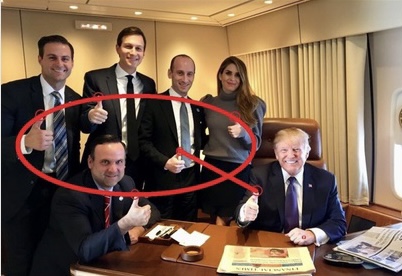
the Q-Anon conspiracy is sprawling and labyrinthine, not so much hiding in plain sight as advertising its existence at every conceivable opportunity, because, as they believe, the satanic pedophile cabal can’t help telling on themselves, and the forces for good battling against the evil are also out here steady giving weird signals. and the signs are everywhere, dude: “once you start to recognize them, you can’t not see them.” everything means something. for example, here’s a seemingly innocuous picture:

more than meets the eye?

it’s a pretty straightforward picture, or so you might think, if you’re still asleep. but if you know, you know:

oh, word?

by simply drawing a line connecting all the thumbs-up gestures from all these garbage people, we can clearly see that a Q is formed, which might be an unmistakable signal that the good guys are in control and the Storm is coming. do your research, pay attention, and it’s right there in front of your face.

unless…

trump’s head looks photoshopped, right?

the situation pt. 2

if you go to the wikipedia page for situation awareness, it quickly becomes clear that the concept is much more complex that it seems on the surface (like pretty much everything is). most of this complexity (or, at least, what i’m most interested in) comes from the three major modes of the concept: perception, comprehension and projection. this is to say, perception of the environment and elements in a given situation, comprehension of their significance, and projection, based on that information, of future status.

the Theoretical model section, then, goes into detail on this idea, including a review of a model formulated by Mica Endsley, an engineer and former Chief Scientist of the USAF. Endsley’s model uses the perception (which is designated Level 1 SA), comprehension (Level 2 SA) and projection (Level 3 SA) terminology, as well as “illustrates several variables that can influence the development and maintenance of SA, including individual, task, and environmental factors.” it also occasions exactly the kind of criticism you would expect a theoretical framework to receive, which is always fun.

two of the model’s “several key factors” are particularly interesting (again, to me):

  • The role of information salience in “grabbing” attention in a data-driven fashion, and the importance of alternating goal-driven and data-driven processing
  • The role of expectations (fed by the current model of the situation and by long-term memory stores) in directing attention and interpreting information

all emphasis mine. 🤔

the situation.

there is a place for me in the military, apparently. so they say. or, so this one guy said one time. i was told, by this dude, that my capacity for awareness of what’s going on around me is actually a desirable skill, one that is useful for the military.

my partner and i were dining with this fellow and his wife, at a restaurant we’d never been to before, and someone at the table mentioned some item on the menu that sounded interesting. i replied that i’d noticed someone being served that dish as we were being led to our table by the host, that the guy over my left shoulder wearing a Tom Brady jersey was probably still eating the thing right now, if they wanted to take a look. the husband (part of the military himself, holding some really specialized position that i never really was able to understand) immediately diagnosed me as possessing excellent situational awareness, which is, basically, exactly what it sounds like: “the perception of environmental elements and events with respect to time or space, the comprehension of their meaning, and the projection of their future status.” he explained that people who have the ability to observe and process environmental information at a really high level (which he had determined, from the fact that i noticed what some guy was eating in a restaurant, i had the ability to do) were very valuable, because they could analyze situations and make recommendations about how and when to take actions. the example he gave was watching a bunch of shops, where there was suspected terrorist activity. someone with this skill might notice that a particular customer who comes in every morning around 9am is absent one day, which might be meaningful and help prevent the loss of life (by, you know, probably causing the loss of someone else’s life).

it actually reminded me of one of my first appointments with my first therapist. i can’t remember what we were talking about, but she stopped and asked me to close my eyes. she said that she did this all the time with clients, asking them to tell her everything they could remember about the room we were in, explaining that, usually, people were unable to describe the room accurately at all and couldn’t recall any correct details. it was an exercise, i think, to illustrate something about how out of touch we actually are with ‘reality,’ showing that we can’t even describe a room that we’re currently sitting in. i’m not totally sure if that was the goal, but what i do remember is that i fucking crushed it, rattling off the smallest details about things like the brand of computer monitor she had and the names of the board games stacked up on a small shelf by the door. she stopped my inventory of the office, remarking that she’d never had anyone answer this challenge so thoroughly and accurately, and i felt sufficiently good about myself (while she, no doubt, adjusted her still-forming understanding of how and why i’m a fucking disaster). recalling that episode felt like some kind of confirmation of this military dude’s assessment of my ability to assess.

so i guess i got that to fall back on. ¯\_(ツ)_/¯

the commercial (standup)

Yooooooo, grandparents, right?

We all got em, and they’re all fucking racists. I mean, I do, and, being a white guy, I’m assuming that, even if my own particular experience isn’t, in fact, universal (a ‘fact’ which I’m suspicious of), it’s at least quote-unquote universal in the sense that I can expect that you are all aware of it and will appreciate me referencing it. Am I right, folks? Don’t understand that as an actual question that suggests interest in your own subjectivity, because, like I said, I’m a white guy and, as such, I expect we are all here to have my idea of fun. Woo. I don’t know if this is a common enough thing to evoke the kind of nostalgia and reassurance that we’re all here for, but my two grandmas were absolute polar opposites in temperament. Is this a thing? Grandma on my dad’s side (we called her Grandma Big, because she was like 4 ft. tall) was just the nastiest old woman you’d ever want to meet. Had a scowl and a bad word for everyone. Grandma on my mom’s side (we called her Grandma Auncie, which was also not her real name, but rather some old Hungarian shit that I never knew what it meant, maybe related to organized crime) perpetually sounded like her fucking cookies just finished baking, all sweetness and light. (My mom, of course always reminded us that it was all an act, that the Grandma Auncie she was raised by was a heartless killer.) That’s definitely recognizable, right? I got you with that one, I know it. Don’t tell me you’re not nodding your head and smiling and feeling warm about that shit. But anyway, totally different grandmas. For real, I always felt bad for Grandma Big, though. My grandpa (Grandpa Big, he took her nickname when they married) was the star of that relationship. He lived one of those Don Draper Depression lives where he built hisself up from nothing, and everyone (except him, of course) breathlessly repeated the details of his mythic origin at any opportunity. The bullshit story was that his stepmom tried to kill him with a cleaver, so he left home at twelve and started working. He taught himself how to play multiple musical instruments and toured with big bands. He went off to fight in The Big War. He had an offer tour and make a good living as a musician, playing in a notable band, but he gave it all up to marry my grandma. He built the house my dad grew up in with his bare hands. Of course, everyone also acknowledged that Grandma Big had her own story: she married my grandpa. I have no idea why she was so sour and dissatisfied all the time. The Fucking Greatest Generation. I know this is relatable. Don’t you sit there and act like it’s not.

the commercial (haikus)

Sit, perfectly still.

Love envelops, ignorant.

Please leave me alone.

___________________________________

This is family. Loud,

unaware; I hate them. It’s

not just neuroses

___________________________________

This impatience to

leave. Refusal to engage.

Oh, a commercial.

__________________________________

the commercial (first year composition)

Anxiety can come in many forms; fear of abandonment, fear of failure and fear of commitment are just a few common types of anxiety. For the past several years, Americans have disagreed about the issue of anxiety. Many people believe that anxiety is a serious problem that can affect people’s lives, and that it can and should be treated. On the other side of the issue, some people argue that anxiety is not real, that it is used as an excuse to explain away weakness and laziness. From my own experience, however, I know that anxiety over social situations is real, because I experience it even around my own family, and additionally, there are even commercials advertising medication to treat that anxiety.

When I am in a social situation, I feel intense anxiety. I have felt this anxiety my whole life, anytime I am in an unfamiliar social situation, or even sometimes in familiar settings. For example, my family simply spending time with my grandparents on Christmas Eve can cause feelings of distress. My grandma might be drinking her ‘Sprite’ (which is actually vodka) and my brother might be talking on the phones with his friend, while my dad is paying all of his attention to my grandpa (whose mind is slowly falling into the fog of dementia), and, of course, my mom will be only thinking about how much she hates my dad; but my anxiety convinced me that they are all focused on me and judging me. This is because anxiety is real. 

Additionally, there are actually medications to treat anxiety like my own, that arises from social situations. A recent commercial claims that “You feel like everyone’s judging you,” which shows that social anxiety is real and how it affects people. The commercial says that there is a drug that can help treat social anxiety, which is very positive for people like me, who suffer from this problem. The fact that a major drug company is producing a drug to treat social anxiety shows for a fact that it can be seen as real, and that it can be overcome. 

The issue of race also comes into social anxiety, which is something that was brought to light in the recent Black Lives Matter protests. Because of racial injustice in society, it adds even more social anxiety to African Americans and other minorities, which is not fair. Even though African Americans have more freedoms today, racism is still a part of the modern world, which is something that has to stop. However, defunding police is not the answer, because it will not do anything to stop black on black crime in the African American community.

Social anxiety is real, and it is being treated more and more with medication. If Americans do not understand that social anxiety is a disease and not a personal choice to be lazy, then racism will continue. 

the commercial

I remember the first time I heard the phrase ‘social anxiety disorder.’ I was twenty-one years old, and I was watching television with my family on Christmas Eve. We were at my father’s parents’ house, and we were all watching A Christmas Story (or something like that), because otherwise we would have had to talk to each other. I was (like everyone else, I assumed) running out the clock, patiently waiting for someone else to announce that they needed to leave, so that I could quickly announce that, well, I, too, should probably get going. My grandma was drinking her usual; Sprite ‘with a little vodka’ in it that actually contained so much vodka, and so little Sprite, that you could never seem to locate a single bubble in her glass. She occasionally announced that she had no idea what was going on in the movie. My grandpa was laughing whenever he saw my dad laugh, to make it seem like he was following the action on the television. My dad was laughing extra loud to make sure my grandpa could notice it. My mom was making disgusted faces every time my dad did or said anything. My brother was on the phone with one of his friends. We all ignored my grandma when she exclaimed, again, that she had no idea what the hell was going on. 

As I was wondering if I could just go ahead and be the first to announce I was leaving, a black and white animated commercial appeared on the television. It was really simple, just a little oblong blob with a dot for eye, a line for an eyebrow and a downturned line indicating distress for a mouth. The narrative voice-over began, softly inquiring if you ever had the feeling of being uncomfortable. Well, yeah, of course. 

Like you’re afraid of being criticized? 

Um, yeah, kind of. I began to pay attention.

Like everyone is judging you?

Yes. All the time. I was starting to become uncomfortable.

The little animated blob was trying to enter a party, but he was unable to. He stood in the doorway, watching all the other, happy blobs having a good time. He contorted and became red with shame.

You’re always embarrassed, but you’re not sure why.

At this point, I was trying my best not to betray how interested I was in what this guy was saying.

You always stay back, away from the group. You worry that you’re the only one who has these feelings.

I realized that he was talking about me. At the bottom of the screen were the words Symptoms interfere with regular life. The thought flashed through my mind that this was a joke, that somehow this commercial was produced and someone paid for it to air on cable television just to fuck with me and humiliate me, to make me think there wasn’t anything wrong with me, because that would be funny. The narrator said that I might not be alone, that I might be one of millions of Americans who suffered from social anxiety disorder. I was simultaneously elated and mortified. 

It’s possible to overcome this anxiety.

I doubted that, but I was still very interested in the concept. Social anxiety disorder. This was a real thing that someone decided it was worthwhile to name, a diagnosis. Even if it was just pharmaceutical companies who invented a condition to sell drugs, that was still good. They recognized that there are enough people with this anxiety to bother exploiting them. To bother exploiting us.  At the bottom of the screen, new words appeared:

Social Anxiety Disorder is a serious medical condition

They capitalized it—a proper title. 

As the narrator did all the disclaimer stuff, the sad little blob’s redness faded, and his mouth line gradually curved in the opposite direction. He joined the other blobs and began having fun. I wanted to burst out of my seat and rush to campus, to a computer lab to do some research, but I stayed as still as I was able to. I was positive that everyone else (including my oblivious grandpa, drunk grandma, and disinterested brother) was noticing the commercial, and that they were making the same connection that I was, that they also knew that it was talking about me. I was sure that they could see how the commercial was making me feel. I knew that they knew it was talking about me, so I couldn’t react. I had to just act like I was as bored and detached as I had been all night. I took off my glasses and pretended to inspect them, scratching at some non-existent speck that wouldn’t come off the lenses. I knew they knew, so I had to do my best to make sure that they didn’t know that I knew that they knew, or even that there was anything to know. I needed them to know that I didn’t care, because I don’t know who that guy in the commercial was talking about, but it wasn’t me.